


03.11 - Agios Georgios Methystis:
From the Dragon Legend to the Village Celebration in Pitsidia
Every place has its own traditions. Small and large celebrations passed down from generation to generation, keeping the stories, customs and values of its people alive.
In Pitsidia, a small village in Southern Crete, November 3rd is one of those special days. It is the feast day of Saint George, also known as “Methystis.” A day that brings together religious tradition, local history, wine and, of course, a traditional Cretan celebration.
But who was Saint George? Why is he called “Methystis,” and what is the story behind the dragon we see in his icons?
Saint George and the Legend of the Dragon
Saint George is one of the best-known and most beloved saints of the Orthodox Church.
In many icons, he is depicted riding a white horse, holding a long spear with which he slays a dragon.
Behind this image lies an ancient legend.
According to Christian tradition, a terrifying dragon lived near a city, spreading fear among its inhabitants. To appease the creature, the people were forced to offer sacrifices.
One day, when it was the king's daughter's turn to be sacrificed, Saint George appeared on his horse.
With courage and faith, he confronted the dragon and defeated it, saving the young woman and freeing the city from fear.
This story is part of the later legends surrounding the saint and is not considered a historically documented event.
Its symbolic meaning, however, remains timeless.
The dragon represents evil and fear, while Saint George symbolises courage, faith and the strength to face whatever threatens us.
Perhaps that is why the image of the saint on horseback remains so recognisable, even after so many centuries.
Why Is Saint George Celebrated Twice a Year?
Most people are familiar with Saint George's feast day on April 23rd, when the Orthodox Church commemorates his martyrdom.
However, there is also a second feast day, on November 3rd.
On this day, the Church commemorates the transfer of Saint George's relics to Lydda in Palestine.
So, it is the same saint, not two different people.
The difference lies in the event the Church commemorates on each occasion.
In Crete, however, the November celebration has acquired a rather special traditional name.
Why Is He Called “Methystis”?
The answer lies in one of rural Crete's oldest and most cherished traditions: winemaking.
November is traditionally the time when wine from the autumn harvest has finished fermenting or is nearing the end of the process.
The barrels are opened, and people taste the year's new wine.
Saint George's feast day on November 3rd became associated with this custom, giving the saint the nickname “Methystis,” which roughly translates as “the Wine-Loving Saint.”
The name has nothing to do with the saint's life or martyrdom, but rather with the folk traditions that developed around his feast day.
On an island like Crete, where vineyards and wine have long been an essential part of rural life, this connection is hardly surprising.
After all, wine here has always been more than just a drink.
It has always been, and remains, a symbol of hospitality, togetherness and celebration.
A glass of wine is often an invitation to sit together, share stories and enjoy each other's company.
And so, a religious celebration became connected with a deeply rooted tradition of everyday life.
Saint George's Celebration in Pitsidia
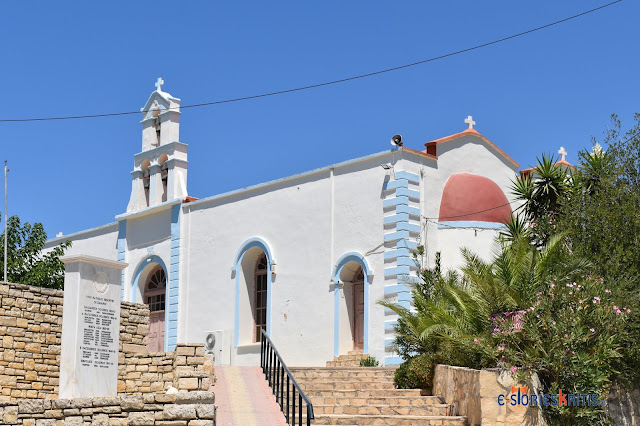
In Pitsidia, the feast of Saint George “Methystis” is much more than just a date on the calendar.
For many years, it has been a cherished local tradition that brings the village community together.
Every year on November 3rd, the celebration continues with a traditional afternoon gathering in the village square.
It is an opportunity for people to meet, exchange good wishes, share a glass of wine and celebrate together.
Because in Crete, celebrations are about much more than simply having a good time.
They are a way of keeping the bonds between people strong and passing traditions from one generation to the next.
And perhaps that is the most beautiful part of all.
A Tradition That Continues to Bring People Together
In a world where so much changes so quickly, it is comforting to see that some traditions remain.
That people still gather in the village square, celebrate together and keep their traditions alive.
The celebration of Saint George “Methystis” in Pitsidia is a gentle reminder that the true beauty of a place lies not only in its landscapes.
It also lies in its people, their stories and all the little things that bring them together.
And these are the things that make a village so much more than just a beautiful destination.
They make it a place with soul.
Further articles
5 things locals never rush to do
5 πράγματα που οι ντόπιοι δεν βιάζονται ποτέ να κάνουν Υπάρχουν μέρη που σου μαθαίνουν να τρέχεις. Και υπάρχουν και μέρη που, χωρίς καν να …
Matala Beach Festival 2026 - Will it take place? What we know & what to expect - Every summer, Matala changes its rhythm. The sea remains the same, the sun sets in the same place…
Philotimo in Practice - Everyday Attitudes that Make a Difference - In the previous article, we spoke about philotimo as a value and a way of thinking. In practice, however...
Philotimo: The Honour of Giving Without Expecting in Return
Philotimo: The Honour of Giving Without Expecting in Return - "You don’t need a thank you to know you did the right thing. You feel it inside.."

The Oleander Gorge. An Unforgettable Excursion. The island of Crete is full of natural beauty, and the Agiofarago Gorge is undoubtedly one of the most impressive destinations...
Feminal – In Genuss. 12.05.2025 – 15.05.2025. Pleasure and mindfulness are two essential elements that significantly influence our well-being and quality...